
What We Learned from CCC Digital Learning Day
 Via the Online Counseling Network (OCN), counseling faculty statewide are participating in synchronous online counseling which allows them to replicate a face-to-face (f2f) meeting. Working this way has revealed nuances that counselors need to be aware of. I will share two today.
Eye Contact
The position of your computer camera can impact your eye contact as it can present a nonverbal appearance that you are distracted or uninterested even though you may be staring directly at the student on your computer screen. Camera placement can make a significant difference in how you build rapport online. If you have a camera embedded in your computer monitor, I recommend you adjust your monitor to a position where your camera and eyes are horizontally aligned and level. Positioning your camera in such a manner will present a level of eye contact similar to your f2f counseling appointments. If you have a camera separate from your computer monitor, I recommend you either purchase a stand so that you can place the camera at eye level or buy a camera that you can place on the top of your computer monitor and adjust to your eye level.
Student Engagement
During an online counseling appointment, student participation is an essential component to address student learning outcomes (SLO). For example, many counseling departments include an SLO focusing on applying educational planning so that students can identify course requirements that enable a student to pursue their educational goal/s (e.g., associate degree and transfer requirements). A vital nuance is to allow students the ability to moderate some of the session so they can navigate resources such as your online catalog, key websites (e.g., assist.org), and other vital components that enable students to build a meaningful educational plan that is collaborative and critical to the learning process. As a result, students are increasing their educational cultural capital which contributes to their success and college readiness. Educational cultural capital is student’s mastery or preparedness of the college student role (Aschaffenburg & Maas, p.573, 1997). 2008), so the more educational cultural capital a student has then, the students will gain a more in-depth knowledge of their academic expectations.
One of the aspects as a community college counseling faculty I enjoy is growing my knowledge base and implementing new strategies in my counseling sessions, as this helps me become effective in my approach with students. The more you take time to engage in online synchronous counseling the more you will implement effective practices that address the nuances of online counseling. Stay tuned for future posts that discuss other nuances when providing synchronous online counseling.
To learn more about Online Counseling check out our webpage.
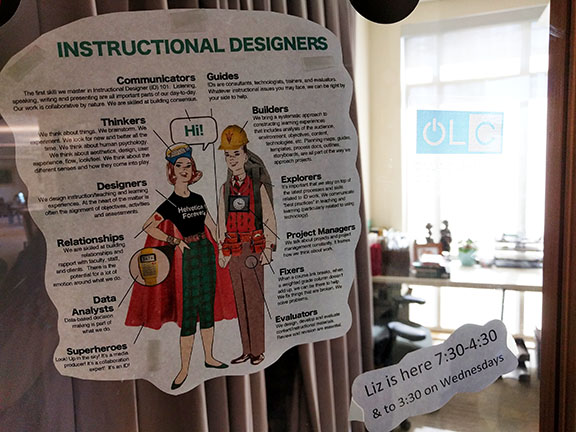
My office door with an illustration by Robert Kilman from the Arizona State University website TeachOnline
When I began my position as the Instructional Designer in Distance Education at Santa Rosa Junior College (SRJC) in the Fall of 2015, my new supervisor printed the illustration shown in the photo above and gave it to me. I taped it to my office door. Who wouldn’t like to be depicted as a fashionable superhero-explorer with a split personality? It’s also a pretty good representation of an action-packed job that marries creative thinking with technical problem-solving. Flexing different parts of my brain throughout the day keeps me excited about my work and on my toes.
Among the many roles I play, the one I reflect upon the most is Relationship Builder. The caption for the illustration states: “We are skilled at building relationships and rapport with faculty, staff, and clients. There is the potential for a lot of emotion around what we do.” The emotion was immediately evident to me at SRJC. My position was created at the same time that our college adopted Canvas to replace Moodle and a home-grown system called CATE. Emotions were loud and clear: many faculty felt overwhelmed by the transition, especially when it meant significantly reorganizing course materials to accommodate the Canvas interface.
Fortunately, many of those faculty attended our in-person Canvas workshops and appointments for help, and I was able to calm nerves by listening carefully to their concerns and providing support. I also encouraged faculty to share problems and solutions with each other. Building face-to-face relationships came easily to me and helped faculty make the transition.
Now that the transition to Canvas is complete, fewer faculty attend our in-person workshops and more often send me emails and enroll in my online courses and programs. I am happy to provide support remotely, but I find that building meaningful relationships with new faculty now requires more deliberate planning and cultivation. I’ll share two of my strategies:
- I now use ConferZoom to “meet” new faculty who take our Online Special Expertise certificate training, a six-week online course that I teach in Canvas. I offer Zoom sessions each week, and participants are required to attend at least one session. The stated purpose of this requirement is for faculty to experience the Zoom interface as a teaching tool, but I also value the sessions for relationship building. Conversations take off into many directions, just as they do in person. Sometimes the encounters are even more personal than they would be in person --I’ve met more than a few babies, kids, and pets through Zoom! I’ve also invited guests to join us, including @ONE’s Michelle Pacansky-Brock and Lené Whitley Putz.Zoom session require advance planning (although on occasion I launch Zoom screen-sharing for support calls). For the Online Special Expertise sessions, I survey participants at the start of each course to determine everyone’s availability. I then post session dates as ungraded Assignments in Canvas so the “due dates” appear in Modules, on the Calendar, and in the To Do list. I set up Outlook meetings as a reminder. I also make appointments with faculty who can’t make the sessions, and I note session attendance in Grades to be sure everyone participates. Building new relationships makes it worth the effort.
- I interview faculty for my Online Faculty Spotlight video series, which I post on our DE Blog and on YouTube. Response to the series has been very enthusiastic because a common request I hear from faculty who are new to online teaching is to see example Canvas courses. I ask the faculty I interview to imagine they are sharing their course with a colleague who has never taught online before. It’s the type of interaction that might happen informally in offices or workshops, but many of our adjunct faculty miss out on those opportunities for interaction.Some faculty I invite for interviews are hesitant to be recorded at first, but I sit next to them at my computer and we have a conversation while recording with Screencast-o-matic. I promise to edit out anything embarrassing to put them at ease. I ask them to give me a “tour” of their course and explain their teaching goals and strategies. I usually include the webcam so it’s clear who is talking. The videos foster relationships among faculty who may never meet otherwise.
My future plans, if I ever find the time, is to do a podcast. The only slack time I have during the day is lunch, so perhaps I’ll call it “Lunch with Liz at SRJC.” I won’t pull off something as slick as Teaching in Higher Ed while eating, so perhaps I’ll have informal lunch conversations with faculty about kids, pets, or favorite fonts. I keep meaning to get a Helvetica Forever t-shirt.

Learn more about the Robert Kilman's Instructional Designer infographic.
Get Ready for CCC Digital Learning Day
Digital learning is anchored in connection and sharing. That's why @ONE (Online Network of Educators) is hosting CCC Digital Learning Day on February 22, 2018. The day will be a statewide, untethered professional development experience that will explore the various ways the digital era is reshaping teaching and learning, as well as how we communicate and share with one another and our students. Our CCC event will be part of the 7th annual national Digital Learning Day, comprised mostly of K12 schools conducting face-to-face events. We invite you to join in!
Free registration for the online events will be available on February 14th. Until then, here are a few ways you can get ready!
Make #CCCDLDay Your Own
CCC Digital Learning Day is a new event for @ONE, and we are very excited about it. Our primary goal is always to support your needs and that is one of the reasons CCC Digital Learning Day is unique. @ONE will host a series of online sessions -- from national thought leaders, your CCC peers, and our students -- that will be enhanced by your local campus events. Currently, we have 18 campuses signed up to host group viewing rooms for the sessions, experimentation labs, and more. View our campus activity list to see what's happening on your campus, contact with your campus coordinator to learn more, or sign up if you don't see your campus on the list (the doc is editable so just click and type!). We even have flyers and other promotional resources available to support your efforts.
Share Your Story in our Video Contest
When you reflect on how your formal and informal learning have changed as a result of our digital era, what stories come to mind? Share them with us! Our CCC Digital Learning Day Video Contest is open through February 12th. We've got some great prizes lined up for students and faculty/staff. Learn more and help us spread the word!
Attend our Webinar this Thursday to Get Ready
Register for the free webinar, Get Ready for CCC Digital Learning Day, on Thursday February 8th at 1pm PT to connect with @ONE and your peers about what's happening on February 22nd.
Tweet Your Love!
Share your enthusiasm, questions, or ideas about CCC Digital Learning Day with the hashtag #CCCDLDay. We are listening.
Tweeting Your Way to Professional Growth
This post is the third in a series about principles in teaching and learning with contributions by Jim Julius and Lene Whitley-Putz.
 Social media is a topic that stirs a mixed bag of reactions with college educators. Some shake their heads and speak of a generation of souls lost on screen-time, superficial Snapchat stories, and fake news. While each of those topics are worthy of a critical discussion, social media means something very different to other educators, like myself. To me, the topic sparks a reflection about lifelong professional growth and development.
I have had a very non-traditional career path for a college educator. And through the ups and downs of my journey, I have benefited tremendously from my participation in social media. As I look back on roughly ten years of blogging and tweeting, I identify countless virtual connections that have grown into meaningful professional relationships, I’ve become a more well-rounded, reflective practitioner from the resources shared by peers, and I even received an offer to write a book along the way.
And now, in my new role with @ONE, my team and I are shepherding educators into the networked era by designing professional development opportunities fueled by social media to improve their digital literacy and prepare students for professional and personal success after college. Through the use of our new hashtag, #CCCLearn, we are helping educators to demystify hashtags by lurking in our feed or by sending a Tweet with the hashtag #CCCLearn that describes what they’re learning/trying/reflecting on. We also just kicked off our first @ONE Reflective Writing Club, a 6-week community-based blogging experience designed to support educators in examining the unique opportunities and challenges of public, digital writing (peek into our journey by searching for the hashtag #CCCWrite on Twitter or viewing this RSS feed of our blog posts).
Along the way, I realized that educators embarking upon their first experiences with social media as a form of professional growth may need advice and some guidance. As I looked back on my own journey, I asked myself, “What do you know now that you wish you had known then?” To answer this question, I searched the web for existing resources, but did not find what I had in mind. I located many institutional policies about social media, most written through the lens of public relations or marketing. But I did not find a concise and focused resource supporting professional learning. So I wrote my own and, in the process, reached out to a few of my peers, Jim Julius, Katie Palacios, and Lene Whitley-Putz, for some feedback. The five finished principles are provided below. They draw upon my own practices and experiences with social media and I hope they will serve many of you as you embark on their own journeys.
5 Social Media Principles for Professional Growth
Beginning a journey to become a lifelong digital learner can be a daunting task, especially for educators who are used to having all the answers. The principles below are offered to help you get started, guide you, and motivate you through the twists and turns ahead. Enjoy your journey!
Experimentation
As you look down the path in front of you, you may feel uncertain about where you are headed and how you will get there. Keep wondering about what’s ahead; curiosity will keep you moving forward. You’ll need to make choices that you may feel uncertain about at times. That’s why becoming a digital learner is, in many ways, like a long-term experiment. As you try new things, remember to look back and recognize what you would like to do differently next time. Trial-and-error is a way of life in digital culture.
Kindness
As you start your journey, you may question the value that you have to contribute to the public web. Self-doubt is common when engaging in an open digital community. Remember that you are surrounded by individuals who feel the same way. When you participate, you are taking a leap of faith and you will recognize and appreciate those who are kind to you. When others take the time to comment on your work, make it a priority to listen and respond.
Community
Know that you are not alone in this endeavor. Being a digital learner means you are part of a community. Lean on others for support and, in return, encourage your peers. Give to your community by sharing your ideas, your resources, and engaging in dialogue. Over time, you will begin to see your generosity come back to you in unexpected and beautiful ways.
Mindful Participation
Developing a professional learning network is a fulfilling experience, but it is a practice that involves care and attention. Because the lines between our digital and physical networks may blur, it is important to be clear about setting and maintaining boundaries. As you engage, take care to set priorities, be present when in the company of your family, friends, and co-workers, and allow yourself to take a break. In digital culture, all of your actions matter. Develop a practice that involves pausing to consider your words before you publish/tweet/post. Sometimes choosing not to comment can be the wisest choice to make.
Curation
As you grow and change, your professional learning network should too. Developing your PLN is a continuous process of refinement that involves filtering out the noise. At the same time, making a conscious choice to seek out and include diverse perspectives in your network can open your eyes to new ways of seeing things.
If using Twitter and blogs for professional growth is new to you, are these principles helpful? If you are an experienced user of social media, do they resonate with your experiences? Leave us a comment below and let us know!
Social Media Principles for Professional Growth by Michelle Pacansky-Brock is shared with a Creative Commons-Attribution CC-BY 4.0 International License.
Two Sides of the Same Coin: Online Teaching and Course Design
This post is the second of a series about principles in teaching and learning with contributions by Jim Julius and Michelle Pacansky-Brock
 Like Fred and Ginger, peanut butter and jelly, the Patriots and the Super Bowl, some things are so closely linked that they simply don’t make sense without the other. For online education, how we design our course and how we teach our course are the inseparable pair--two sides of the same coin.
The professional development program developed by @ONE has long focused on both sides of this coin. In 2011, we used the iNacol Standards for Quality Online Teaching as the criteria for our online teaching certificate, and in 2014, we customized these standards to develop the @ONE Standards for Quality Online Teaching. The @ONE Standards were the foundation for the design and teaching practices that underpinned the @ONE Certificate in Online Teaching, representing both sides of the coin in one essential set of standards.
In 2014, though, the Online Education Initiative developed the OEI Online Course Design Rubric. This rubric focused solely on foundational criteria for course design, and pushed the shared standards for designing quality courses well beyond the @ONE Standards. Over the course of two years, as the rubric was used by faculty across the state, it went through some major revisions, and sets a gold standard for course design quality. In essence, the OEI Rubric advanced the initial design criteria offered in the @ONE Standards.
This caused a bit of a rub when using the @ONE Standards. Participants moving through the @ONE courses sometimes struggled with determining which set of standards or criteria they should be privileging. Participants in our courses were not always able to see which document was driving course design decisions--the Rubric, or the Standards. Moreover, as technology changed, and as more data about student success in online learning became available, we realized that the teaching practices outlined in the @ONE Standards needed some careful revision to better reflect the mission of the California Community Colleges (CCCs), including an emphasis on student success and equity.
So, this fall, we drew upon the collective wisdom of experienced online teachers from across our system in a collaborative effort to articulate a set of teaching principles that reflect the specific needs of our students, staff, and faculty. Our first step was to remove the course design elements--now the purview of the OEI Course Design Rubric--and focus our attention on the other side of the coin, the practices and behaviors that support quality online teaching.
Working from the original set of standards and resources that helped us better understand the national dialog around great online teaching (including those outlined by Jim in his post on Monday), carefully examining data about our online students, and drawing on the knowledge and expertise of our peers across the system, we developed a set of principles for quality Online teaching tailored to the CCCs. The principles state that effective online teachers:
- Are present within their course;
- Apply equitable methods to promote student access and success while acknowledging institutional obstacles;
- Respond to student needs and use data for continuous course improvement;
- Teach and model ethical online interaction, while helping students develop digital literacy that will poise them for success;
- Recognize ongoing professional development is a central component of their success.
We would like to invite you to read the full text of the Principles for Quality Online Teaching, and hope the principles give you some ideas to mull over and discuss with peers. Most importantly, we invite you to participate in developing our communal understanding of these principles by joining us in a webinar, writing a blog post, or participating in a course.
We think the pairing of the new Principles for Quality Online Teaching with the OEI Course Design Rubric lays the foundation for your success and the success of our students, but the reality is, Ginger and Fred engaged in a lot of practice before they became Hollywood legends. The Principles provide the initial steps for the intricate dance of teaching and learning, but our continued conversation and engagement with one another is the music that breathes life into the dance.
Teaching--face-to-face and online--is hard work, and our students may need to surmount many walls along their path to success. The Principles remind us that the unique mission of the CCCs is not to separate the wheat from the chaff, but rather recognize the human potential in all of us.
Using Principles to Guide Professional Practice
This post is the first of a series about principles in teaching and learning with contributions by Lené Whitley-Putz and Michelle Pacansky-Brock.
 In early December, Inside Higher Ed published an article on the need for a theory of learning in which the authors, Chew and Cerbin, decried a “buzzword wasteland” and pursuit of “simplistic solutions” in higher education teaching and learning. Comments on the article were fascinating, and I was drawn into a subsequent Twitter discussion. (The Twitter conversation included Michelle Pacansky-Brock, who encouraged me to expand upon my thoughts here.)
The primary concern of Chew and Cerbin is that too few faculty are guided by a “valid theory of learning” informed by cognitive research on how students learn. They acknowledge that a theory meeting this perceived need would be complex, and has yet to be developed. Yet they believe that development of such a theory is a prerequisite for college teaching to become a “coherent set of effective practices.”
Theory vs. Best Practices vs. Principles
As a former K-12 teacher and teacher educator who has been working at the intersection of technology and faculty development in 2- and 4- year institutions for the past 15 years, I understand the desire to see educational practice consistently grounded in some sort of coherent theory. But in my experience, while some college faculty find discussion of the distinctions between connectivism and various flavors of constructivism mildly stimulating, most would prefer to cut to the chase - just tell me what works.
At the other end of the educational development spectrum, this leads to the proclamation of “best practices,” a concept that has origins in regulatory compliance in the business world. Because teaching and learning is affected by many contextual factors, evidence-based conclusions about the effectiveness of pedagogies and technologies can be difficult to reach. Sharing practices that have some evidence of effectiveness is great, but perhaps we could strive for a bit more nuance and contextualization.
For me, the sweet spot in teaching and learning between theory and “best practices” is principles. A good set of principles typically has a coherent theoretical underpinning, as well as at least some evidence of effectiveness. Good principles provide direction without overspecifying implementation. Principles are most effective in faculty development when they are accompanied by a variety of examples in order to illustrate multiple applications in varied contexts.
An oft-heard phrase in educational institutions these days is initiative fatigue. A common language to describe our collective work may help to counter this sense of fragmentation of efforts focused on the latest iteration of identified problems and solutions. At the institutional level, this language often consists of mission and vision statements, shared values, and institutional outcomes. Most institutions have these, but their authenticity and utility varies greatly.
I would suggest that at the classroom level, instructors often experience a phenomenon similar to initiative fatigue. Chew and Cerbin point out the many pedagogical trends and technological “advances” which can overwhelm any instructor wanting to remain current in their practice. It’s my belief that individuals and institutions which adopt and use a common, consistently applied set of teaching and learning principles will have an easier time staying grounded.
Finding Principles that Resonate
So, which principles to follow?
For me, Chickering and Gamson’s (1987) 7 Principles for Good Practice in Undergraduate Education have aged well. Research and experience continue to affirm the simple message that
“Good practice in undergraduate education:
- Encourages contact between students and faculty
- Develops reciprocity and cooperation among students.
- Encourages active learning.
- Gives prompt feedback.
- Emphasizes time on task.
- Communicates high expectations.
- Respects diverse talents and ways of learning.”
For the most part, these principles speak to faculty as teachers, informing our teaching behaviors. But faculty, especially in the community college system, are also designers of learning experiences and environments. Some have taken Chickering and Gamson’s principles as starting points to provide teaching and design guidance aimed at online instructors (see examples from VCU and from my own MiraCosta College).
Other useful principles focus on more specific aspects of learning, teaching, and the design of learning experiences and environments.
- Principles derived from cognitive science research provide guidance about factors affecting learning such as developmental stages, metacognition, motivation and emotion, social interaction, and memory (e.g. Angelo’s Teacher’s Dozen; Merrill’s First Principles of Instruction; How People Learn; Thiagi’s 14 Laws of Learning)
- Other principles from cognitive science research focus specifically on the design of learning experiences and use of media (e.g. Mayer’s Principles of Multimedia Learning; 25 Principles of Learning)
- Humanistic principles focus on the learner as a whole person and learning as a natural act (e.g. Carl Rogers’ principles of learning)
- Still other principles are derived from research on effective teaching for learners who historically have not been well served by educational institutions (e.g. Universal Design for Learning, Equity by Design, Culturally Responsive Teaching)
If you review every link above - good on you. Hopefully you’ll feel inspired and informed, and will start to see common threads that speak to you. Please don’t be overwhelmed. There is no expectation that you must be the master and fulfiller of every principle. As Thomas Angelo says, “It's up to individual faculty members to determine which principles apply to whom, when, where, and how.”
But I would love to hear if something above has inspired you. Which of these principles could be helpful to you personally? To your department? Your college? And if you have another set of teaching and learning principles you think is worth adding, please share here!
Using Video to Communicate Instructions Clearly
Video is powerful communication tool for online teaching. Instructors often naturally gravitate towards using video to deliver presentations to their online students, but video can be an effective way to clearly communicate instructions, as well. In the 3-minute video below, Xochitl Tirado, from Imperial College, shows how she uses a screencast (a video recording of her computer's screen) to deliver the instructions for the discussion to her students. The video doesn't replace her written instructions, however. Instead, it augments them and provides students with the choice to read or listen. Xochitl explains how she uses the same instructions in each discussion. Designing a course with consistency like this is an effective way to ensure students gain confidence in their abilities and can focus more exclusively on their contributions, as opposed to how to engage in the discussion.
 I mentally stomped my feet when our counseling faculty recommended that, to better accommodate students, I offer my English 101 course, which is contextualized for first responders and administration of justice majors, online.
But I’m an English professor, I thought. My bread and butter is helping students tease nuance out of text. My job is to steer them toward recognizing a strong critical interpretation while I watch for faces to blink on like a row of streetlamps, circling back to any that are still flickering. In my discipline, I sit with students, knee to knee, eye to eye, and ask them to “read that back to me,” so they can discover for themselves where their prose falters and, together, we can figure out how to improve it. None of this is online work. This is real human connection in the real human world.
After thinking through my discipline-based worries, it appeared I had epistemological ones as well! Isn’t face to face something that our younger students need more of anyway? Don’t they spend enough (way too much!) time on their devices already? And aren’t the socio-emotional skills that are derived from our courses the skills needed to navigating the real world? Such as the skills of problem-solving and working together that come from cooperative learning. Such as the ability to engage in respectful, challenging dialogue with others. Such as the skill of artfully and persuasively expressing their ideas to others.
Yes!
And no.
Making a Mindshift
I have been teaching for some time in the manner in which I settled on in graduate school pedagogy courses. My face-to-face classes mostly go very well. I thrill in the strides my students make, in the many recommendation letters I write, and in the students who keep in touch over the years, and who attribute some of their success to what they learned in my courses. Yet, in my resistance to online teaching, I was neglecting three crucial tenets of teaching: meet students where they are, use content and methodologies that are authentically relevant for students, and let data inform pedagogy.
After a little light research, I began to understand that the skills of critical analysis and expression are needed, perhaps in even more abundance, in the written world (a world whose presence has, perhaps most surprising to us English instructors who were told it was disappearing entirely, only increased). Students are communicating greater and greater portions of their lives through the written word. Between texting, emailing, and social media of all sorts, they are navigating much of the public sphere, the work sphere, and their intimate social spheres, through reading and writing. And I came to believe that students are not being challenged well enough around their virtual written presence.
So I decided to give this online thing a go.
Learning from Peers
Now, I am not afraid of serious effort. I love a good challenge. The phrase it’s going to be a lot of work is more likely to make my eyes light up than to scare me. But online teaching nearly did me in! As many of you know, online differs radically from face-to-face teaching. In order to make my courses meaningful and steer my students toward the outcomes that my face-to-face students achieve, I had to rethink everything.
I was lucky to have friends and colleagues in the DE world who could mentor me. I was able to look at archived examples of online courses that showcased the best and the worst of what can be done in the online format. I saw courses whose instructors who were clearly “phoning it in” and teaching the dreaded “correspondence course.” Those courses echo the most jaded beliefs about online teaching -- that online instructors simply “set it and forget it,” loading a course with multiple choice quizzes and pre-recorded lectures and letting a machine take over. But I also saw courses of great beauty – courses where I wondered how the instructor had time to sleep or eat, so hearty was the ongoing engagement, feedback, and “real-time” response targeted toward each student.
In viewing these outstanding courses, I saw possibilities for a shift in my own discipline-based pedagogical assumptions. What if, instead of looking students in the eye, and prizing their ability to verbally articulate their ideas, what if I were to meet students at their written words and, through a steady stream of “low-stakes” writing assignments, guide them toward thoughtful expression which carefully considers a variety of perspectives and evidence? What if I could go one step further and, through requirements, rubrics, and feedback on their feedback, teach them how to evaluate the written expression of others for these same traits?
Embracing the Differences Online Learning Provides
Thus began my conversion to becoming an online instructor in earnest. Through workshops, trainings, and trial and error, I learned that careful, creative, objective-oriented planning, and consistent communication and follow-through, can create a learning environment in which students can go as far, and perhaps further, than in a face-to-face environment.
In my online courses, students experience a near-daily stream of individualized, yet public, feedback on their writing, as well as private feedback on higher stakes writing assignments. I am able to guide students not only in their own writing assignments, but also in how to provide guidance to other students, who then use that to provide further guidance, which in turn has its own feedback loop, from me, and from peers. And if that sounds like the verbal equivalent of an M.C. Escher painting, I admit that managing the class does sometimes feel just like that. Yet, although class management is complex, the payoff is astounding. I have been seeing students make leaps in achieving clear, thoughtful analysis much earlier in my online classes than in my face-to-face classes. And I am seeing a pattern of stronger overall gains as well.
That discovery alone has been extraordinary. Additionally, I have learned how important online teaching is to student equity. Online courses are a way to level the playing field for students with disabilities, for students with work and family commitments that preclude commute time and campus involvement, and for students with intermittent or “on demand” jobs whose schedules are not consistent.
On the other hand, I am finding online teaching to be more time consuming than face-to-face teaching. While this is certainly a challenge, I’m also energized and motivated by my own feelings of discovery and exploration. Online teaching is newly charted territory and there is a lot to learn, with new data, new or improved technological tools, and pedagogical innovation happening all the time. It is clear to me that there are new discoveries yet to be made, and I am honored to be working with the DE mavericks at my institution, and at @ONE and the OEI.
It’s hard to believe how resistant I once was. These days, when I log into my online courses, I see a vibrancy of student connection and learning. It reminds me of a row of streetlamps coming on, virtually but brightly, one by one.
How Snapchat, Zombies, and Twitter Can Humanize Learning
Recently, I sat down with Mike Smedshammer from Modesto Junior College to discuss his thoughts about humanizing online learning. In our conversation, he shared why this topic is so important to him and the students we serve in the California Community College system. He also shows how he used Snapchat, Twitter, and zombies to make himself more approachable.
Research about online learning shows that having an engaged, caring instructor is a critical part of supporting the success of college students, regardless of a course's modality or the type of institution a student attends. A recent Gallup poll showed that college graduates who recall "having a professor who cared about them as a person, made them excited about learning, and encouraged them to pursue their dreams" had more than twice the odds of being engaged in their work and being personally fulfilled. In fact, that poll showed that meaningful, supportive relationships with instructors played more of a role than the type of institution the student graduated from.
When we hone in on this topic and apply it to students who attend community colleges, it becomes an even more vital component of student success. At community colleges, we serve more students who are the first in their family to attend college. First-generation college students often experience self-doubt, come from lower income households, work full-time, and juggle a complex array of family responsibilities. Further, a 2017 report from Community College Equity Assessment Lab (CCEAL) found that about half of the 2.1 million students enrolled in California's community colleges have worried about where their next meal will come from and one in three feel uncertainty about where they will sleep tonight.
When underserved students learn online, the importance of having an approachable, caring, supportive instructor becomes even more critical. Studies show that community college students who learn online are more likely than face-to-face students to report needing to teach themselves, which is a result of having a poor connection with their instructor. On the flip side, online community college students who report having an instructor who cares about them are more likely to succeed in their class.
The evidence is clear. Instructor-student relationships improve student success, especially in online community college classes.
Creating a safe, trustworthy environment in which our underserved students feel comfortable to approach their instructor, ask questions, and share their challenges is an important part of serving a diverse student population. But when you teach online, you must deliberately and mindfully craft your human presence through the use of digital tools, which can feel like a daunting task. Fortunately, there are plenty of tips and strategies to consider. And @ONE has you covered with a new course coming this spring!
Enjoy the video of my chat with Mike. We invite you to share a comment at the bottom of this page. We'd love to hear your thoughts about the topic of humanizing.
Give 'Em a Clear Learning Path

Not all online courses look the same. That may seem a rather obvious point but it’s one that instructors may not realize regularly presents a barrier to learning for their students.
The Syllabus is over here in one course, and over there in another. The Home page may tell the student how to get started or it may be a Spartan declaration of the instructor’s contact info, the textbook title and nothing more (in some cases, there may be no Home page at all). The discussions in this course are part of the modules, but in that course, they’re accessed through a separate link in the navigation.
The differences aren’t inherently wrong but all this variety can translate to “I’m lost!” for our students.
And when a student is lost, they’re not learning.
5 Tips for Designing Usable Online Courses
There’s a great web usability book entitled, Don’t Make Me Think. Author Steve Krug’s main point is that “when you’re creating a website, your job is to get rid of the question marks.” In other words, make what your web visitor should do so obvious they won’t get distracted by having to think about it (otherwise they’re likely to leave). This principle holds true when creating an online course. Students are more likely to interact with and be successful in a well-designed, intuitive course.
In the 1980s, John Sweller’s research pointed out that extraneous cognitive load (the amount of mental energy expended to deal with non-essential information) can be reduced by good course design. While we don’t want our students to stop thinking entirely ;-), we do want all their thinking powers directed at absorbing our wonderful content, not on figuring out where to find the discussions or how to submit their assignment.
In the spirit of “don’t make me think,” here are five easy-to-implement sign posts that will guide your students to success in your course.
- Make sure there’s a clear starting point
This might be a big Start Here button or a “Do This First” list of steps on your Home page. - Clean up your course navigation menu
Disable any links you’re not asking students to use. For example, there’s no need to include the Discussions, Assignments and Quizzes links since they can get to those through your modules. - Create an intro video for your Home Page
Do a short screencast (not more than 3 minutes) in which you show students how to find the important elements of your course. This does double-duty, as it also builds your “online presence.” - Follow a consistent module structure and naming convention
Inconsistency brings with it confusion. Pay attention to how course elements are titled and placed within your modules to help students avoid spending time figuring out what’s what or what’s next. - Include contextual instructions for activities
Just as you offer some kind of context when introducing an activity in a face-to-face class, it’s important to do the same online. Why are you having them watch this video, what ideas or details should they glean from this article, when will they be expected to use this information?
Invite Someone to Test Drive Your Course
Before publishing your course this coming semester, it’s a great idea to take yourself through it with the eyes of a student who’s unfamiliar with both your topic and with Canvas. Better yet, ask a friend or colleague (or even some Joe off the street) who knows next to nothing about your content to spend 10-15 minutes exploring your course as if it’s their first day of class. Then “interview” them:
- Did you know what to do first, second, third?
- Were you frustrated by anything?
- Was anything unclear?
- Did you get stuck anywhere?
- Did you know how to get help if you were stuck?
I say, “Vive la différence!” when it comes to instructional methods. Variety is the spice of life and, arguably, the essence of a well-rounded education. (It also makes your job more fun!) But save your creativity for your content, not your course structure. It’ll free up your students’ time for learning.
Hello! We are Liezl Madrona and Jayme Johnson, and we support faculty with accessibility in the Online Education Initiative. We are happy to bring you the first in an ongoing series of blog posts about accessibility in online education. It is our hope to build awareness and provide support so that all students can benefit from online instructional technologies.
Where to Begin?
The question of accessibility in online education brings up so many different issues and concerns that it can be a bit difficult to know where to begin. Whether you're a content creator seeking guidance or you're an accessibility specialist trying to provide guidance, the number of different considerations surrounding accessibility in online education can be overwhelming. However, there is good news in that we are not alone, and that there are growing numbers of people learning ever more about accessibility and usability. With this increase of interest comes greater understanding and more helpful resources for everyone.
'tis the Season for Captioning!
While the holiday season is upon us, we also know many faculty are working on their online courses, adding content and making adjustments based on their experiences in this last term. This is a great time to create your welcome videos for the new term, to curate and create new instructional videos, and to get them all captioned for your incoming students.
- Need someone to caption an instructional video that you’ve created?
- 3CMediaSolutions is free for all California Community Colleges - captioning will be done for you!
- Have a video you’ve created, and you can make time to caption it yourself?
- Use YouTube for DIY captioning. Please read our other blog post for more information on how to caption videos that you own and those that you don’t.
- Have a video you don’t own that needs captioning?
- Use Amara for free DIY captioning. You can then link from Canvas to the captioned video in the Amara player. We've heard rumors of a tool being developed that will allow you to embed the captioned video directly into your course - stay tuned!
- Need a tool for creating captioned videos to use in your course?
- Screencast-O-Matic is a faculty favorite - it’s easy to use, the yearly subscription (which includes basic editing and special effects) only costs $18!
Here are some other incredibly helpful resources to support your accessibility needs:
- CCC Accessibility Center: resources and assistance for IT accessibility.
- Distance Education Captioning and Transcription (DECT): Captioning and transcription grant for online video.
- High Tech Center Training Unit (HTCTU): DSPS professional development.
- OEI Online Accessibility Resource Documents: Collection of resources for faculty creating online instruction.
In our work with the Online Education Initiative there is one common necessity that drives our efforts - the ultimate usability of the information and resources we provide. We appreciate your attention and effort, and it is our sincere hope that we can assist you in your efforts to ensure that all students have the same opportunity to benefit from online education. Please follow our blog for more accessibility support, updates, and news!
Thank You!
Liezl & Jayme
