
Online Course Design Rubric Transition Hub
Accessibility Note: The information presented on this page is provided in an accessible text format. Graphics and infographics are included as visual summaries and alternate means of representation to support understanding and engagement.
The 2027 Online Course Design Rubric builds on the strengths of the current rubric while modernizing the framework to support today's online learning environment.
The updated rubric introduces new areas of emphasis including Universal Design for Learning (UDL), Artificial Intelligence (AI), Privacy & Security, Equity & Inclusion, and a new approach to accessibility. During the transition period, colleges may continue using the current rubric while preparing for implementation of the 2027 Course Design Rubric.
Transition Timeline
Summer 2026
- 2027 Online Course Design Rubric released
- Companion resources and training become available
Fall 2026 – Fall 2027
- Transition period
- Colleges may adopt the new rubric or continue using the current rubric
- Faculty and reviewers prepare for implementation
Fall 2027
- 2027 CVC Online Course Design Rubric becomes the official rubric for review and badging
Access the 2027 Online Course Design Rubric
The 2027 Online Course Design Rubric is available in multiple formats to support individual review, local implementation, and collaborative planning.
Choose the format that best meets your needs.
What's New?
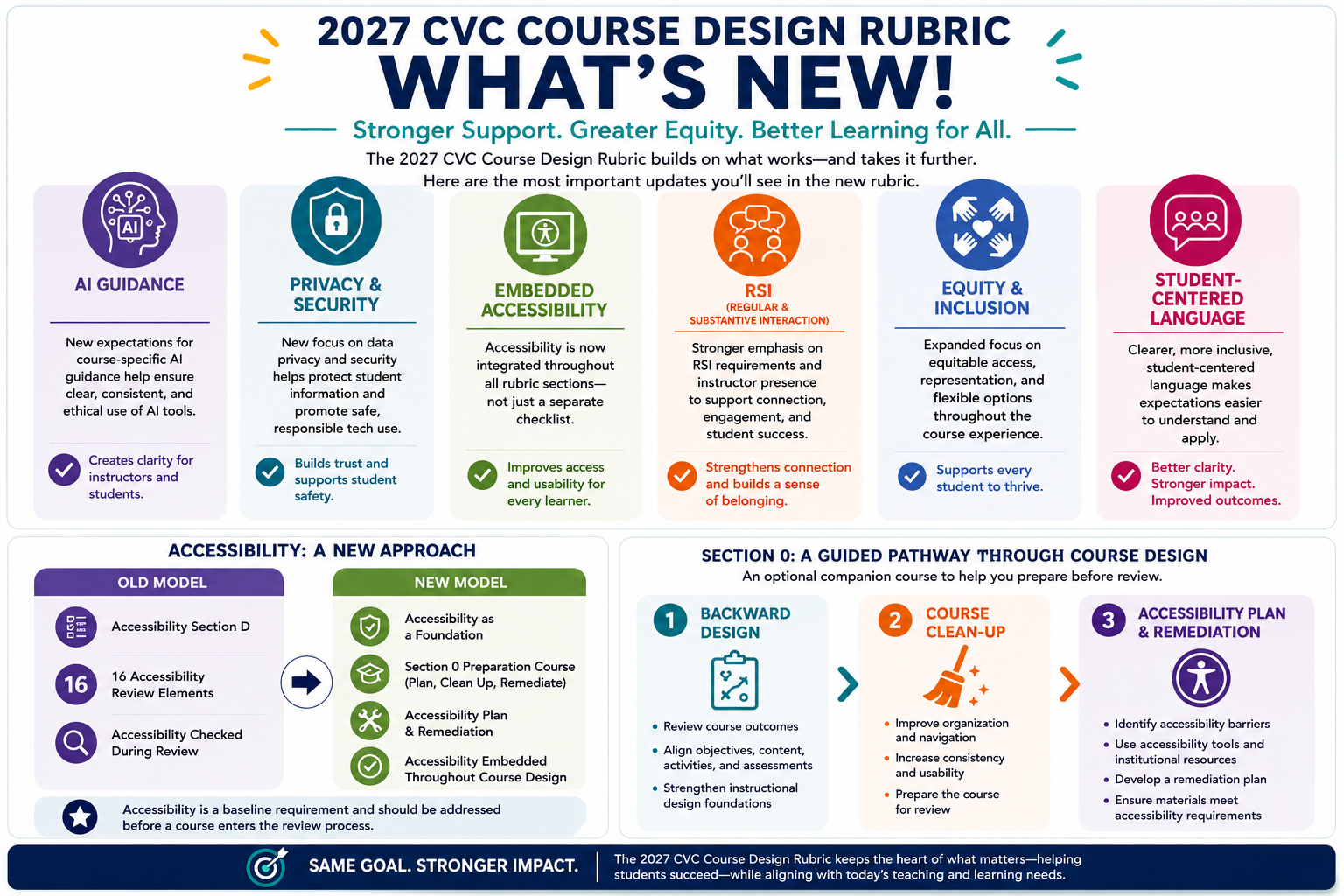
Explore the Major Changes
The sections below provide a high-level overview of the most significant updates in the 2027 Online Course Design Rubric.
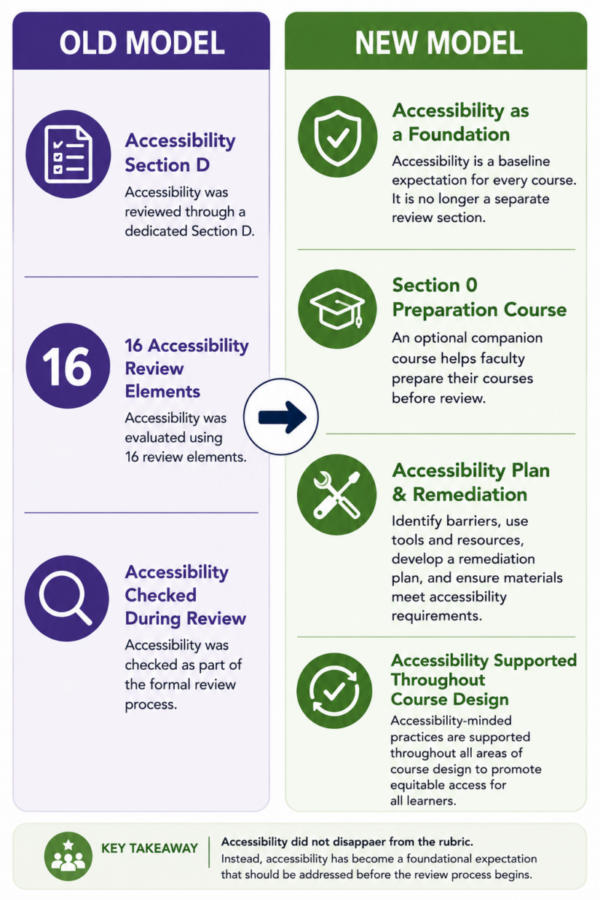
Accessibility: A New Approach
The 2027 Online Course Design Rubric introduces a new approach to accessibility. Rather than evaluating accessibility through a dedicated review section, accessibility is treated as a foundational expectation that should be addressed before the review process begins.
Explore Key Topics
Artificial Intelligence (AI)
The 2027 Online Course Design Rubric introduces a dedicated AI element focused on transparent communication and responsible use of artificial intelligence within the learning environment.
Privacy & Security
The rubric includes a new focus on student data privacy, digital safety, and responsible technology use.
Equity & Inclusion
Equity and inclusion are intentionally embedded throughout the rubric to support learner variability, belonging, and equitable access.
Implementation Resources
Section 0: A Guided Pathway Through Course Design
An optional adoptable course that helps faculty prepare courses before review through backward design, course clean-up, and accessibility planning and remediation.
Keep the Badge
Guidance for faculty with previously badged courses transitioning to the 2027 CVC Course Design Rubric.
Rubric Crosswalk
Compare the current rubric and the 2027 Online Course Design Rubric to understand how sections and elements have evolved.
Reviewer & POCR Lead Resources
Access training, norming sessions, implementation guidance, and companion resources designed to support reviewers and POCR Leads as they transition to the 2027 Online Course Design Rubric.
Frequently Asked Questions
The 2027 Online Course Design Rubric is the updated version of the CVC Course Design Rubric. It builds on the strengths of the current rubric while introducing new areas of emphasis related to accessibility, artificial intelligence (AI), privacy and security, equity and inclusion, student-centered design, and meaningful learning experiences.
The rubric is released in Summer 2026 for soft adoption. A transition period will occur from Fall 2026 through Fall 2027, allowing colleges time to prepare for implementation. Full adoption begins in Fall 2027.
No. During the transition period, colleges may continue using the current rubric while preparing for implementation of the 2027 Online Course Design Rubric.
Major areas of change include:
- Accessibility: A New Approach
- Artificial Intelligence (AI)
- Privacy & Security
- Regular and Substantive Interaction (RSI)
- Equity & Inclusion
- Student-Centered Design
- Assessment Enhancements
Visit the What's New in the 2027 Online Course Design Rubric page to learn more.
Accessibility is no longer reviewed through a standalone section. Instead, accessibility is treated as a foundational expectation and supported through accessibility-informed course design practices, institutional accessibility processes, and Section 0: A Guided Pathway Through Course Design.
Section 0: A Guided Pathway Through Course Design is an optional companion resource designed to help faculty prepare courses before review through backward design, course clean-up, and accessibility planning and remediation.
Colleges may choose to adopt Section 0 locally, and CVC@ONE will offer a facilitated version beginning in Fall 2026.
Yes. Courses that have earned the original QR badge will continue to be recognized during the transition period.
The original QR badge is scheduled to retire in Fall 2030, at which point only courses awarded QR Badge 2.0 will display a badge.
Not necessarily.
Most currently badged courses already align with many rubric expectations. Colleges will determine their own local transition processes, and many courses may require targeted updates rather than extensive redesign.
The Transition Hub includes resources for:
- Faculty
- Reviewers
- POCR Leads
- Institutions
Available resources include:
- Section 0: A Guided Pathway Through Course Design
- Keep the Badge
- Rubric Crosswalk
- Reviewer & POCR Lead Resources
- Topic-specific guidance for Accessibility, AI, Privacy & Security, and Equity & Inclusion
Visit the topic pages linked throughout the Transition Hub for detailed information about: Accessibility Artificial Intelligence (AI) Privacy & Security Equity & Inclusion QR Badge 2.0 Transition Reviewer & POCR Lead Resources
Same Goal. Stronger Impact.
The 2027 Online Course Design Rubric continues to support high-quality online learning while helping colleges address emerging expectations related to accessibility, equity, AI, privacy, and student success.
