

Artificial Intelligence (AI) in the 2027 CVC Course Design Rubric
Artificial intelligence (AI) is rapidly changing teaching, learning, and student work across higher education. The 2027 CVC Course Design Rubric introduces a dedicated AI element to help ensure students receive clear guidance regarding the use of AI within a course.
The goal is not to require or prohibit AI. Instead, the rubric encourages transparent communication so students understand how AI may or may not be used within the learning environment.
By clearly communicating expectations, faculty can help students make informed decisions, engage responsibly with technology, and better understand how AI relates to course learning outcomes.
AI Guidance Through Transparency
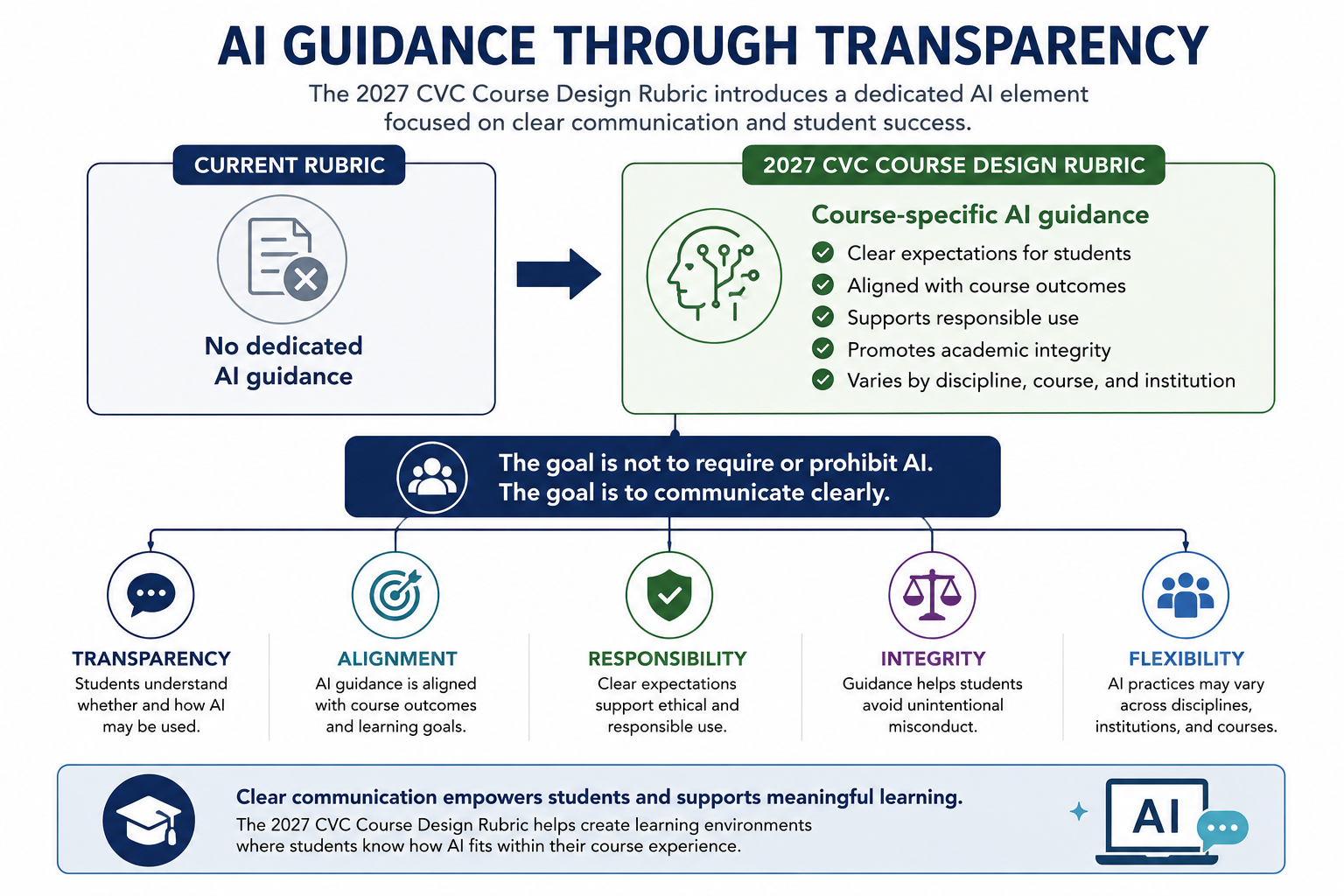
Current Rubric
The current rubric does not contain a dedicated AI element.
2027 CVC Course Design Rubric
The rubric now includes a dedicated AI element focused on communication, transparency, and student success.
What Changed?
Students should not have to guess:
- Whether AI is permitted
- How AI may be used
- When AI use is prohibited
- What responsible AI use looks like in the course
The rubric encourages instructors to communicate expectations clearly so students can understand how AI fits within the learning environment.
Key Takeaway
The focus is not on requiring AI. The focus is on providing clear guidance to students.
The rubric encourages instructors to provide course-specific guidance regarding the use of artificial intelligence.
Guidance may address:
- Whether AI is allowed
- Appropriate uses of AI
- Inappropriate uses of AI
- Documentation or disclosure expectations
- Relationships between AI use and course learning outcomes
- Academic integrity considerations
The rubric recognizes that AI expectations may vary across disciplines, institutions, assignments, and instructional approaches.
Key Takeaway
Students should understand how AI fits within the course and what responsible use looks like.
The 2027 CVC Course Design Rubric does not:
- Require instructors to use AI
- Require students to use AI
- Require a specific AI policy
- Require a specific AI tool
- Endorse any particular AI platform
Faculty retain the authority to determine how AI aligns with their course outcomes, disciplinary practices, and instructional goals.
Key Takeaway
The focus is transparency, not standardization.
Important Note
The examples below are provided for illustrative purposes only. They are intended to demonstrate a variety of approaches that may align with the rubric.
These examples are not required language, recommended language, or model policies. Institutions and instructors should develop guidance that reflects their local policies, disciplinary expectations, course outcomes, and teaching practices.
Example Approach: AI Permitted
An instructor may allow students to use AI tools for activities such as brainstorming, generating ideas, receiving feedback, or supporting revision.
The course guidance would clearly explain how AI may be used and any expectations for disclosure or attribution.
Example Approach: Limited AI Use
An instructor may permit AI for selected activities while restricting its use for certain assignments or assessments.
The course guidance would clearly identify when AI use is permitted and when it is not.
Example Approach: AI Prohibited
An instructor may choose not to allow AI use for course assignments or assessments.
The course guidance would clearly communicate those expectations and explain how they support course learning outcomes.
Key Takeaway
Different approaches may align with the rubric when expectations are clearly communicated to students.
AI guidance should complement existing academic integrity expectations.
Clear communication can help students:
- Understand ethical technology use
- Avoid unintentional misconduct
- Make informed decisions
- Develop discipline-specific skills
- Understand instructor expectations
The rubric does not replace institutional academic integrity policies. Instead, it encourages instructors to provide course-level guidance that helps students navigate emerging technologies responsibly.
Key Takeaway
Transparency helps students engage with technology responsibly and supports academic integrity.
Frequently Asked Questions
No. The rubric does not require instructors or students to use AI.
No. Instructors may determine whether AI use aligns with their course outcomes and instructional goals.
No. The rubric encourages clear communication but does not prescribe a specific policy or set of expectations.
Yes. Instructors may prohibit AI use if that approach supports course learning outcomes and expectations are clearly communicated.
No. The rubric does not endorse or require any specific AI platform or technology.
Faculty should follow institutional guidance while providing course-level expectations that help students understand how AI relates to the course.
Transparency Supports Student Success
The 2027 CVC Course Design Rubric recognizes that AI practices may vary across disciplines, institutions, and courses. Rather than prescribing how AI should be used, the rubric encourages clear communication that helps students understand expectations and engage responsibly with emerging technologies.
