
Rubric Crosswalk
The 2027 CVC Course Design Rubric builds upon the current rubric while reorganizing elements, introducing new areas of emphasis, and reflecting evolving expectations related to accessibility, equity, artificial intelligence, privacy and security, and student success.
This crosswalk provides a high-level comparison between the current rubric and the 2027 CVC Course Design Rubric to help faculty, reviewers, and institutions understand how the framework has evolved.
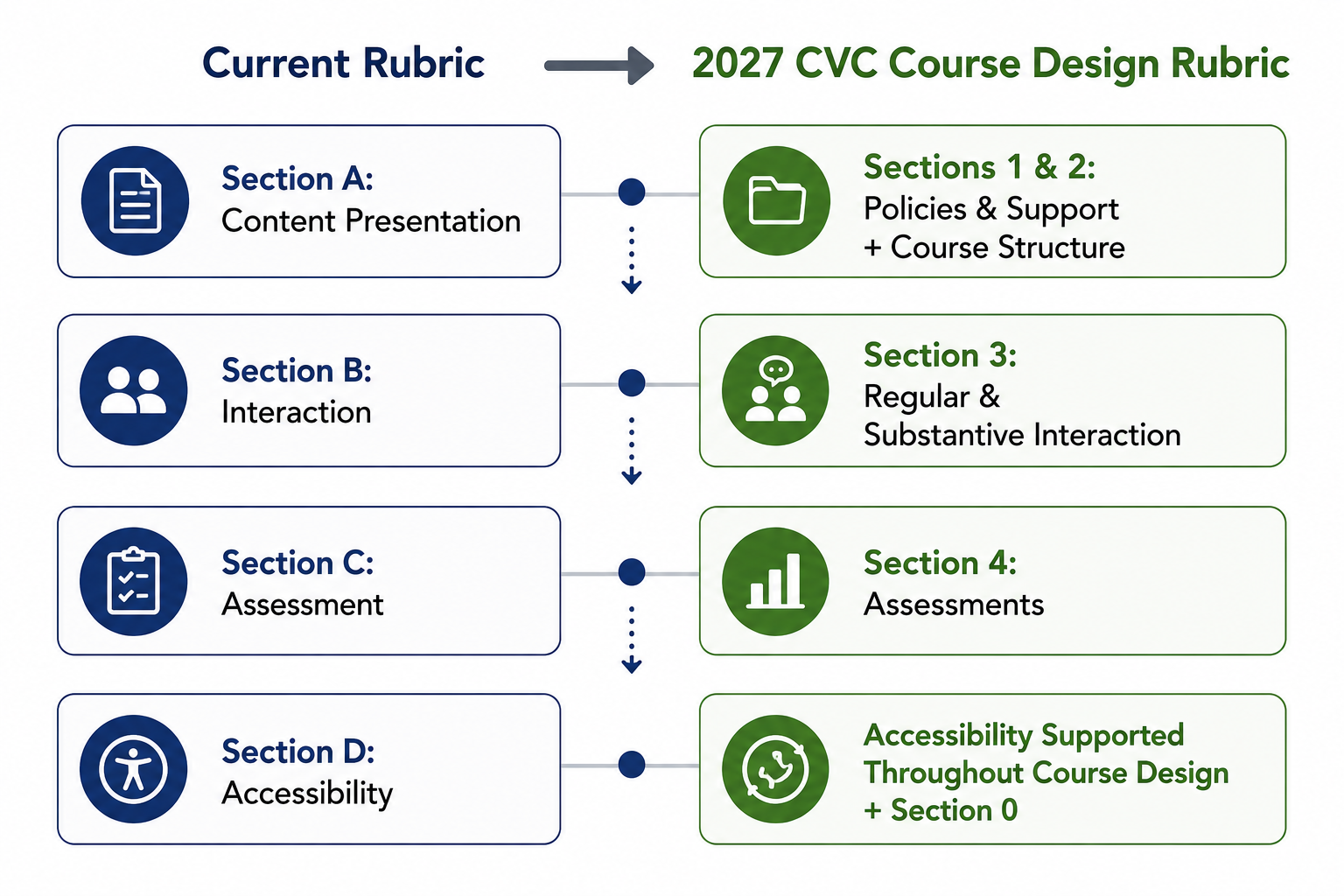
At a Glance
| Current Rubric | 2027 CVC Course Design Rubric | What Changed |
| Section A: Content Presentation | Sections 1 & 2 | Reorganized into Policies & Support and Course Structure |
| Section B: Interaction | Section 3: Regular & Substantive Interaction (RSI) | Stronger focus on instructor presence and meaningful interaction |
| Section C: Assessment | Section 4: Assessments | Expanded emphasis on assessment variety, reflection, and feedback |
| Section D: Accessibility | Accessibility Supported Throughout Course Design + Section 0 | Accessibility reframed as a foundational expectation supported through course preparation and remediation |
| Current Rubric | 2027 CVC Course Design Rubric |
| A12 Course Policies | 1.1 Course Policies |
| A14 Technology Support | 1.2 Equitable Use of Technology |
| NEW | 1.3 Artificial Intelligence |
| NEW | 1.4 Privacy & Security |
| A13 Student Services | 1.5 Student Resources & Support |
| A10 Learning Support | 1.6 Learning Support |
What's New?
The 2027 CVC Course Design Rubric expands the support section to address emerging technologies, student privacy, and equitable access.
New areas include:
- Artificial Intelligence (AI)
- Privacy & Security
- Equitable Use of Technology
The section also strengthens connections to student support services and learning resources.
Key Takeaway
This section moves beyond traditional course policies to support students in navigating today's digital learning environment.
| Current Rubric | 2027 CVC Course Design Rubric |
| A4 Course Navigation | 2.1 Structure & Navigation |
| A1 Placement of Objectives | 2.2 Module Objectives |
| A2 Clarity of Objectives | 2.2 Module Objectives |
| A3 Alignment of Objectives | 2.3 Module Alignment |
| A7 Effective Use of CMS Tools | 2.4 Canvas Tools & Apps |
| A8 Effective Use of Multimedia | 2.5 Use of Multimedia |
| A9 Instructions | 2.6 Guidance for Working with Content |
What's New?
This section places greater emphasis on:
- Student-centered design
- Course usability
- Inclusive content presentation
- Clear guidance and scaffolding
- Representation and belonging
Key Takeaway
The focus shifts from course organization alone to the overall learner experience.
| Current Rubric | 2027 CVC Course Design Rubric |
| B1 Pre-Course Contact | 3.1 Initial Course Contact |
| B2 Regular Effective Contact | 3.2 Instructor-Initiated Interaction |
| B3 Student-Initiated Contact | 3.3 Student-Initiated Interaction |
| B4-B6 Interaction Elements | 3.4 Facilitation of Student Interaction |
What's New?
Interaction is now organized into a dedicated RSI section that aligns more closely with federal and accreditation expectations.
Additional emphasis is placed on:
- Instructor presence
- Student belonging
- Meaningful interaction
- Learning-focused communication
Key Takeaway
The goal is not simply interaction, but interaction that actively supports learning.
| Current Rubric | 2027 CVC Course Design Rubric |
| C3 Variety | 4.1 Variety & Frequency |
| C4 Frequency | 4.1 Variety & Frequency |
| C5 Rubrics/Scoring Guide | 4.2 Scoring Criteria |
| C6 Assessment Instructions | 4.3 Assessment Instructions |
| C7 Feedback | 4.4 Assessment Feedback |
| C8 Self-Assessment | 4.5 Learner Self-Reflection |
| A11 Learner Feedback | 4.6 Learner Feedback Survey |
What's New?
The assessment section expands beyond evaluation to support learning throughout the course.
New areas include:
- Learner self-reflection
- Learner feedback surveys
- Inclusive assessment practices
- Enhanced feedback processes
Key Takeaway
Assessment is viewed as both a measure of learning and a tool that supports learning.
Current Rubric
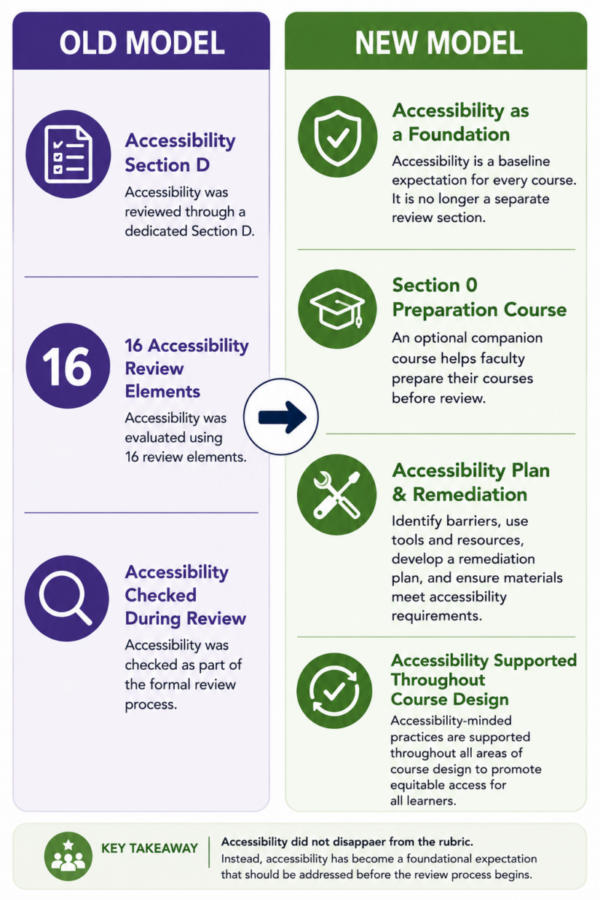
Accessibility was reviewed through a dedicated Section D containing 16 accessibility review elements.
2027 CVC Course Design Rubric
Accessibility is no longer a standalone rubric section.
Accessibility is now treated as a foundational expectation that should be addressed before a course enters review.
The rubric supports accessibility through accessibility-informed design practices, while Section 0: A Guided Pathway Through Course Design helps faculty prepare courses through accessibility planning and remediation.
Key Shift
The focus has moved from:
Checking accessibility during review
to
Preparing accessible courses before review.
Although the rubric structure has evolved, many foundational expectations remain the same.
The 2027 CVC Course Design Rubric continues to emphasize:
- Clear course organization
- Aligned learning outcomes
- Meaningful instructor presence
- Quality assessment practices
- Student support resources
- Accessible course design
- Student engagement
Key Takeaway
The updated rubric builds upon a strong foundation while reflecting current regulations, emerging technologies, and evolving best practices in online teaching and learning.
Same Goal. Stronger Impact.
The 2027 CVC Course Design Rubric continues to support high-quality online learning while helping colleges address emerging expectations related to accessibility, equity, AI, privacy and security, and student success.
This page will likely become one of the most visited resources during the transition period because it gives faculty, reviewers, and administrators a quick way to understand how the new framework is organized without requiring them to read the entire rubric.
